
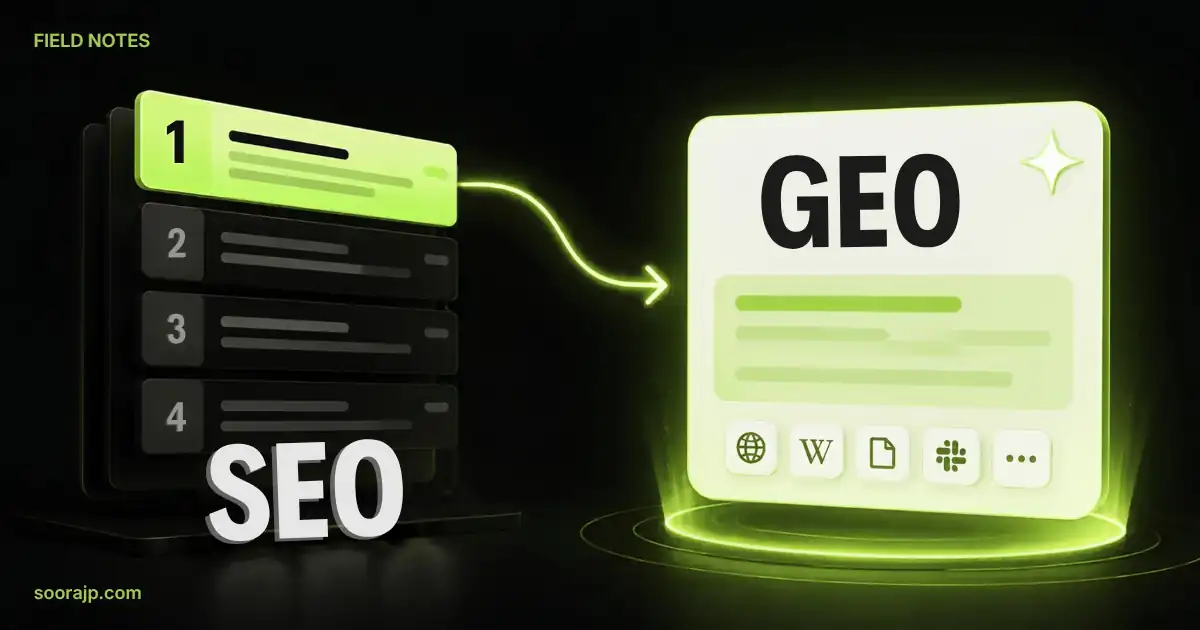
GEO means optimising for answers written by AI systems. Many guides present it as a new discipline. The evidence is more mixed. Google says no extra steps are needed for its AI features. One research paper reports gains from specific tactics, with limits. This guide separates what is documented from what is opinion, and ends with a short action list.
What GEO means
GEO stands for generative engine optimisation. The goal is to be used and cited in answers written by AI systems.
SEO aims to rank pages in a results list. GEO aims to be part of a written answer.
| SEO | GEO |
|---|---|
| Results page with ranked links | A written answer with a few cited sources |
| Measured by rankings, clicks and impressions | No standard reporting from the assistants |
| Search Console reports exist | No official mention report from the assistants |
What Google says about its AI features
Google’s documentation is direct. To appear in AI Overviews and AI Mode, a page must be indexed and eligible to show with a snippet.1
| Topic | What the documentation says |
|---|---|
| Extra requirements | No additional requirements, and no special optimisations needed1 |
| How answers are built | Google may use query fan-out, which runs several related searches1 |
| Reporting | Traffic counts in the Web search type of the Performance report1 |
| Controls | Standard snippet controls apply. Google-Extended is a separate control1 |
So for Google, the answer to “what do I change?” is close to “nothing new”. Good SEO already covers it.
What the GEO research claims
A 2023 research paper introduced GEO as a framework and built a benchmark called GEO-bench.2 The abstract reports that some methods can raise visibility in generative engine responses by up to 40 percent.2 It also says results vary across domains.2
What stays the same, and what shifts
| Area | Stays the same | Shifts a little |
|---|---|---|
| Access | Pages must be crawlable and indexable | Also allow the AI search bots you want3 |
| Content | Helpful, accurate, original pages | Clear, quotable passages matter more |
| Structure | Clear headings and plain text | Direct answers near the top of sections |
| Trust | Real authors, sources and updates | Mentions on other sites may matter too |
| Measurement | Search Console and analytics | Sampling prompts instead of ranks |
OpenAI and Perplexity both publish crawler pages. They describe separate bots for search and for training, and they say robots.txt changes can take about 24 hours to apply.3
A short action list
- 1
Check access
Confirm your key pages are indexed and not blocked by robots.txt or noindex.
- 2
Decide your bot rules
Choose on purpose which search and training crawlers you allow.
- 3
Write direct answers
Put a short, clear answer under each question heading, then add detail.
- 4
Keep facts consistent
Make sure your name, services, location and prices match across your site and profiles.
- 5
Sample and log
Run a fixed set of prompts on a schedule and record mentions, citations and errors.
How I approach it
I do not sell GEO as a separate service. I treat it as a check on top of good SEO.
I also tell clients what I cannot measure. Honest limits build more trust than a confident number.
Common mistakes
Treating GEO as a replacement for SEO.
Quoting “up to 40 percent” as a guaranteed gain.
Blocking search bots while trying to block training bots.
Rewriting all content for AI tools and forgetting readers.
Reporting a rank in an AI answer.
Quick questions
Do I need a separate GEO strategy for Google?
Google says no extra requirements or special optimisations are needed for its AI features.1
Is GEO proven to work?
One paper reports gains in a test setting, with variation by domain.2 Real-world proof on live products is thin, so stay cautious.
Will AI answers cut my traffic?
I cannot answer that for your site. Google counts AI feature traffic in the Web search type, so it is hard to split out.1
Where do I start?
Start with the short action list above. Access and clear writing come first.
Key takeaways
GEO sits on top of SEO. It does not replace it.
Google says AI features need no extra requirements or special optimisation.
One paper reports up to 40 percent visibility gains, with limits. Treat it as a ceiling.
Allow the search bots you want and write short, quotable answers.
Sample AI answers on a schedule and fix wrong facts first.