Nobody outside Google knows exactly why one page gets cited in an AI Overview and another does not. That is the honest start. But we do have Google’s own rules, two large studies and a research experiment. This guide puts them together, says clearly where the evidence stops, and gives you a plan you can use this week.
What an AI Overview citation is
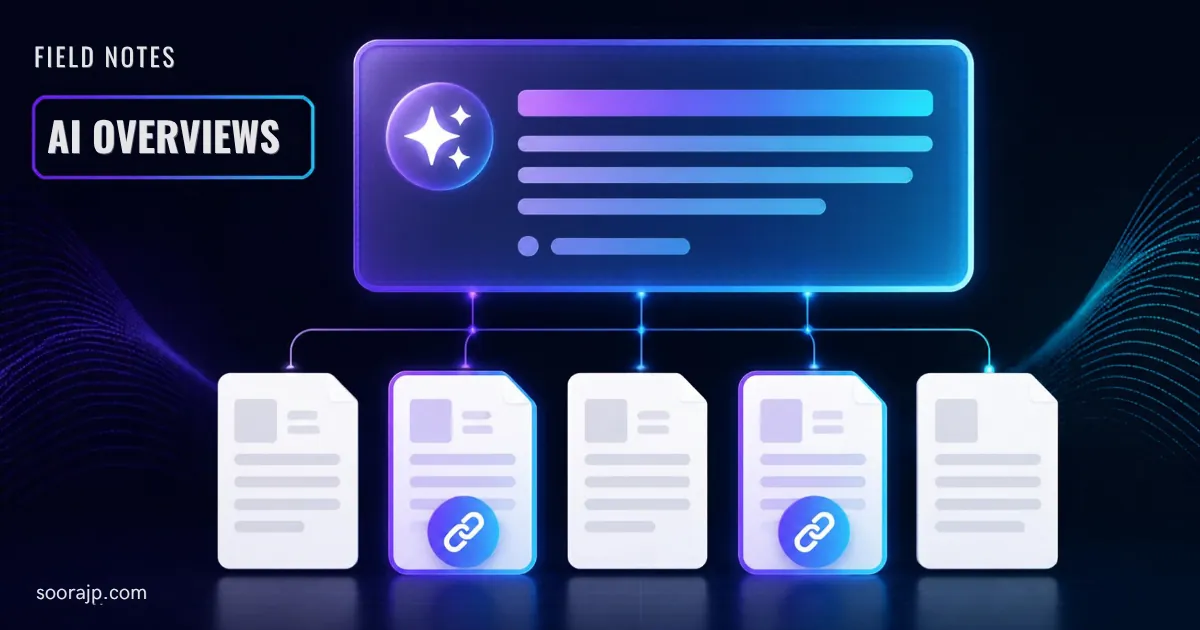
An AI Overview is a short AI-written answer at the top of some Google results. It links out to pages that support the answer. Those links are the citations.
AI Mode works in a similar way, but it gives longer answers and suits harder questions. Google says the two features may use different models, so their links can differ.1
Two details matter here. AI Overviews show only when Google judges them useful on top of normal results, so they often do not trigger. And traffic from both features is counted inside the normal “Web” search type in Search Console.1
What Google says you must do
Google is direct on this point. A page must be indexed and eligible to show a snippet. There are “no additional technical requirements.”1
Google also says you do not need new machine-readable files, AI text files or special markup. There is no special schema for AI features.1
| Question | Google’s answer |
|---|---|
| Do I need a special file? | No. No llms.txt or AI text file is required. |
| Do I need special schema? | No. Keep any markup true to the visible page. |
| Can I limit what is shown? | Yes. Use nosnippet, data-nosnippet, max-snippet or noindex. |
| Is a citation guaranteed if I qualify? | No. Indexing and serving are never guaranteed. |
So the entry ticket is plain SEO. If you want the full list, my crawl-to-citation checklist covers all 25 checks.
Why one question can cite many pages
Google says its AI features may use “query fan-out.” The system splits one question into several related searches across subtopics. Then it gathers supporting pages for each part.1
This changes how you should think about the page. You are not only competing for one keyword. You are competing to be the best source for one sub-question.
Take the question “which CMS is best for a small business site?” A system might also check cost, editing ease, speed and security. A page that answers one of those clearly can earn a link, even if it ranks lower for the main phrase.
What the studies found
Ahrefs ran two large studies on this. They are the best public data I know of, and they disagree in a useful way.
| Study | Sample | Share of citations from top 10 pages |
|---|---|---|
| July 2025 | 1.9 million citations from 1 million AI Overviews | 76.1% |
| Update reported March 2026 | 4 million URLs across 863,000 keywords | About 38% |
The first study counted the top three most visible citations in each answer.2 The update used a wider sample and better parsing. Ahrefs says some of the drop may come from catching citations it missed before.3
It also suggests that query fan-out may play a larger part now. Google has not confirmed any change.3
What the page itself should offer
Google has no citation checklist. But its helpful content guidance gives clear questions for any page. One asks if the page gives original information, reporting, research or analysis. Another asks if it gives substantial value compared with other results.4
A research team added a testable layer. In their experiment, adding quotations raised source visibility by about 41%. Adding statistics raised it by about 31%. Citing sources raised it by about 28%. Repeating keywords lowered it.5
The test used a simulated engine, so treat it as a direction only. But the direction fits Google’s own advice: add real substance, not tricks.
| Trait | What it looks like on the page |
|---|---|
| Original substance | A test you ran, a number you measured, a trade-off you chose |
| Checkable claims | Each fact has a named source and a link |
| Stand-alone passages | Each section answers one question in its first two sentences |
| Clear authorship | A named author, a date and a way to contact them |
A five-step plan for one page
Here is the plan I use. It takes about half a day per page.
- 1
Confirm eligibility first
Check that the page is indexed, returns 200 and has no nosnippet rule. Use the URL Inspection tool.
- 2
Map the sub-questions
Write the five questions a buyer would ask about this topic. Give each one a heading.
- 3
Open each section with the answer
Put the answer in the first two sentences. Add one proof point right after it.
- 4
Add one thing nobody else has
Include your own test, data, screenshot or lesson from a failure. This is your information gain.
- 5
Show who stands behind it
Add the author, the date and a source list. Update the date only when the facts change.
How I think about this
I do not chase AI citations as a separate project. I treat them as a side effect of a page being the best answer to a narrow question.
I also avoid single screenshots of citations as proof. AI answers change between runs. I sample the same ten questions once a month and track the trend, not one lucky result.
Finally, I keep the claim honest. I tell clients that citation is influenced, never controlled. A good page raises the odds and nothing more.
Common mistakes
Buying a tool or file that promises citations from Google.
Treating one AI answer as proof that a change worked.
Writing a long page with no passage that stands alone.
Stuffing the page with the keyword to look relevant.
Blocking Googlebot features by accident with nosnippet or a broad noindex.
Quick questions
Do I need to rank in the top 10 to be cited?
No, but it helps. Ahrefs found 76% of cited pages in the top 10 in 2025, and about 38% in a wider 2026 update. Both studies show non-ranking pages can be cited.
Does schema help me get cited?
Google says no special schema is needed. Use markup that matches the visible page, and treat it as support, not a lever.
Can I stop my content appearing in AI Overviews?
You can limit snippets with nosnippet, data-nosnippet or max-snippet. These also affect normal results, so test the trade-off first.
How do I track citations?
Run a fixed set of questions every month. Record whether you were cited, mentioned or missing. Compare trends over several months.
Key takeaways
Google lists no extra technical rules: indexed and snippet-eligible is enough to qualify.
Query fan-out means one answer can cite many pages, each for one sub-question.
Studies disagree on top-10 overlap (76% in 2025, about 38% in 2026), so avoid single-number claims.
Original substance, checkable claims and clear authorship match both Google and the research.
Measure monthly trends. One AI answer proves nothing.