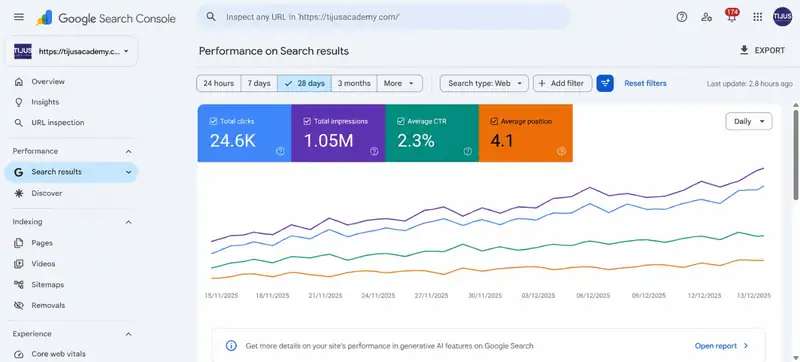
Search visibility that compounds across Google, AI answers and maps.
One system covers SEO, AEO, GEO/LLMO and Local SEO. It starts with clean technical foundations, adds answer-first content and ends with numbers you can read in Search Console.
Google cannot rank what it cannot crawl. A great page on a broken site still loses.
Every page walks this path
1 · Discover
Bots find your URLs
2 · Render
Bots read the page
3 · Index
Page enters the library
4 · Rank
Page earns a spot
Crawlability
01
I check: robots.txt, server errors, redirect chains, internal link paths and orphan pages.
Why it matters: If a bot cannot reach a page, that page cannot rank.
Indexation
02
I check: Index coverage, canonicals, noindex tags, duplicate and thin pages.
Why it matters: Only indexed pages can appear in results.
Site architecture
03
I check: URL structure, click depth, breadcrumbs, hubs and internal links.
Why it matters: Clear structure passes authority to the pages that earn money.
Core Web Vitals
04
I check: LCP, INP and CLS on real user data, plus image, script and font weight.
Why it matters: Slow pages lose visitors before they read a word.
Structured data
05
I check: Organization, Product, Article, FAQ, LocalBusiness and breadcrumb schema.
Why it matters: Schema helps engines understand the page and unlock rich results.
JavaScript rendering
06
I check: What Googlebot sees after rendering versus what the browser shows.
Why it matters: Content that never renders never ranks.
International setup
07
I check: hreflang, language folders, currency and regional duplicates.
Why it matters: The right page should reach the right country.
Migrations
08
I check: URL maps, 301 rules, staging tests and post-launch monitoring.
Why it matters: A careless migration can erase years of growth.
04 · Content and intent
Write for the question, not the keyword.
Every search has a goal. A page wins when it matches that goal better than any other page.
1
Informational
"what is schema markup"
Guides, explainers and short answers. Win trust early.
2
Commercial
"best seo tools for small sites"
Comparisons and reviews. Help people choose.
3
Transactional
"seo audit near me"
Service and product pages with a clear action.
4
Navigational
"soorajp case studies"
Branded pages that are easy to find and trust.
1
Research intent
I read the live results. I note what Google shows and what the top pages miss.
2
Map to the funnel
Each topic gets one page and one job. No two pages fight for the same query.
3
Write answer first
The reply comes in the first 50 words. Detail follows in short blocks.
4
Add first-hand proof
Real photos, data, quotes and lessons from people who did the work.
5
Link the cluster
Every supporting page links to the pillar page, and back again.
6
Refresh on a schedule
I review winners every quarter. Old facts get fixed. Gaps get filled.
Topic cluster · example
Running shoes guide
Best shoes for flat feet
Trail or road shoes
How to pick a size
Washing and care
When to replace
Marathon picks
05 · AEO · Answer Engine Optimization
Be the answer, not just a result.
Many searches now end on the results page. Featured snippets, People Also Ask and voice assistants give the answer right there.
AEO shapes your page so search engines can lift a clean answer from it. Your brand gets the credit.
Illustrative answer box
How long does SEO take to work?
1
2
Most sites see early movement in 3 to 4 months. Strong results usually take 6 to 12 months. Speed depends on competition, site health and content quality.
yoursite.com › guides › how-long-does-seo-take3
1 · Real question. Taken from search data.2 · Answer in the first 50 words. Easy to lift.3 · Clear source URL. Credit goes to you.
Question mining
I collect real questions from People Also Ask, Search Console and customer calls.
Answer-first paragraphs
A direct answer of 40 to 60 words sits right under each question heading.
FAQ and HowTo schema
Markup tells engines which text is the question and which is the answer.
Tables and lists
Steps, comparisons and specs use clean lists and tables. Engines lift them easily.
Plain, spoken language
Short sentences and active voice work for voice assistants and for readers.
Snippet tracking
I track which queries show an answer box and who owns it today.
06 · GEO and LLMO · Generative Engine Optimization
Get cited when people ask ChatGPT, Gemini and Perplexity.
AI assistants write one answer and cite a few sources. Being one of those sources is the new first page.
GEO makes your brand easy to find, easy to trust and easy to quote.
Illustrative AI answer
How do I check if Google has indexed my site?
Open Search Console and use the URL Inspection tool. It shows if a page is indexed and why not. [1] A quick check is the site: search in Google. [2]
It turns one prompt into several smaller searches.
2
It retrieves pages
It pulls pages from search indexes and trusted sources.
3
It judges trust
It prefers clear facts, named authors and sources other sites mention.
4
It writes and cites
It builds one answer and links a few sources. Be one of them.
Where your brand sits in the answer
AI
answer
Your
site
Forum
News
Directory
Reviews
Entity clarity
One clear description of who you are, used the same way everywhere.
Quotable facts
Original numbers, definitions and steps that an AI can lift safely.
Cited sources
Claims link to primary sources. That builds trust with engines and readers.
Off-site mentions
Reviews, forums, press and directories that name your brand.
Bot access
I check robots rules so AI crawlers can read your best pages.
Prompt tracking
A fixed prompt set, checked monthly across the major assistants.
07 · Side by side
SEO, AEO and GEO: same craft, different finish.
They share one foundation. They differ in where the win appears and how you measure it.
SEO
Rank
AEO
Answer
GEO
Cite
Shared
foundation
SEO
AEO
GEO / LLMO
Main goal
Rank pages in results
Be the direct answer
Be cited in AI replies
Where it shows
Blue links, rich results
Snippets, People Also Ask, voice
ChatGPT, Gemini, Perplexity, AI Overviews
Key signal
Relevance, links, page quality
Clear, structured answers
Entity clarity, trust, mentions
Content style
Complete, useful pages
Short answer, then detail
Quotable facts with sources
How I measure
Clicks, position, conversions
Snippet ownership, impressions
Prompt set: mentions and citations
Time to results
3 to 6 months
1 to 3 months
Varies. Tracked monthly.
08 · Local SEO
Win the map. Win the call.
People who search "near me" want to act today. The map pack shows three businesses. Local SEO puts you in it.
Business Profile. Right categories, services, products, photos and hours. Posts and Q&A stay fresh.
Citations. Name, address and phone match everywhere. I clean duplicates and old listings.
Reviews. A simple, honest way to ask. I help you reply to every review.
Location pages. One strong page per area, with real local detail. No copy-paste pages.
Local links. Chambers, partners, sponsorships and local press.
On-page signals. LocalBusiness schema, embedded map and a clear contact path.
Illustrative local pack · "near me"
2
3
1
1
Your business4.9 ★ (212 reviews) · Open now
Call
2
Competitor A4.6 ★ (98 reviews) · Closes 6 pm
Call
3
Competitor B4.4 ★ (41 reviews) · Open now
Call
Calls
Tracked with call tags and profile data.
Direction requests
People on their way to you.
Profile views
Searches that found you.
Review rate
New reviews per month.
09 · By business type
The same system, tuned to how your customers buy.
A store, a clinic and a software company need different first moves.
E-commerce
Main focus
Category pages, product schema, faceted navigation and speed.
First win
Fix duplicate filter URLs and rewrite top category pages.
Local services
Main focus
Business Profile, reviews and location pages.
First win
Rebuild the profile and fix citation mismatches.
B2B and SaaS
Main focus
Use-case pages, comparison pages and demo intent.
First win
Add answer-first pages for high-intent comparisons.
Education
Main focus
Course pages, exam keywords and trust signals.
First win
Structure course pages and add FAQ schema.
Publishers and blogs
Main focus
Topic clusters, freshness and author pages.
First win
Merge thin posts and refresh the top performers.
Health, legal and finance
Main focus
Strong E-E-A-T. Named experts and cited sources.
First win
Add expert bylines, reviews and source links.
10 · Authority and E-E-A-T
Earn trust that Google and AI can both see.
E-E-A-T stands for Experience, Expertise, Authoritativeness and Trust. It is how quality raters judge a page, and AI systems lean on the same signals.
T
A
E
E
Trust sits at the outer edge. It wraps everything.
E
Experience
On the page
Photos, data and stories from people who did the work.
Off the page
Reviews, case studies and user-generated proof.
E
Expertise
On the page
Author bios with real credentials. Accurate, deep content.
Most sites see early movement in 3 to 4 months. Strong, steady growth usually takes 6 to 12 months. Competition, site health and content quality set the pace. I report progress every month, so you see the trend early.
What is the difference between SEO, AEO and GEO?
SEO helps pages rank in search results. AEO shapes content so search engines can show it as a direct answer. GEO makes your brand easy for AI assistants like ChatGPT, Gemini and Perplexity to find, trust and cite. All three share one foundation.
Can you guarantee a number one ranking or an AI citation?
No. Nobody can, and anyone who does is guessing. Google and AI systems change often. I commit to the work, the process and the reporting. I do not promise a position.
Does SEO still matter now that AI search exists?
Yes. AI answers pull from the same web that search engines index. Pages that load fast, read clearly and earn trust get found by both. Strong SEO is the base layer for GEO.
What does a technical SEO audit include?
It covers crawling, indexing, site structure, Core Web Vitals, structured data, JavaScript rendering, international setup and migrations. Every finding gets an impact score and an effort score. The fixes with the best return go first.
How do you measure success?
I use Google Search Console for clicks, impressions, CTR and position. I use GA4 for conversions and revenue. For AI search, I track a fixed set of real prompts every month. You get read access to every tool.
Will you write the content, or only advise?
Both are possible. I build the topic map, the briefs and the page structure. Subject experts add first-hand knowledge, and I edit for clarity and answer-first format. First-hand experience is what makes content original.
Do you build links?
I earn links. I use original data, useful tools and honest outreach to relevant sites. I do not buy links or use private blog networks. They risk penalties and rarely last.
How is Local SEO different from regular SEO?
Local SEO targets the map pack and searches with local intent. It relies on your Business Profile, reviews, consistent citations and location pages. Regular SEO relies more on site content and links.
Do I need to change my website or CMS?
Usually not. I work with WordPress, Shopify, WooCommerce and custom builds. If the platform blocks growth, I explain why and show the options before you decide anything.
What happens to rankings during a redesign or migration?
Rankings can drop if URLs, redirects or content change without a plan. I build a redirect map before launch, test on staging and watch Search Console for weeks after. Most drops are avoidable.
Who owns the data and the documents?
You do. Search Console, Analytics, profiles, documents and code all belong to you. I hand over clear notes so any team can continue the work.
Start a conversation
Let's look at your search data.
Share your site and the outcome you want. You will get an honest read of where search stands within one business day.
Tell me who you are and what you need. I'll follow up with a few questions.
Your privacy
Cookies, your call
I use cookies to keep this site working, understand what helps visitors and make it better. Choose what you are comfortable with. Read the privacy policy.