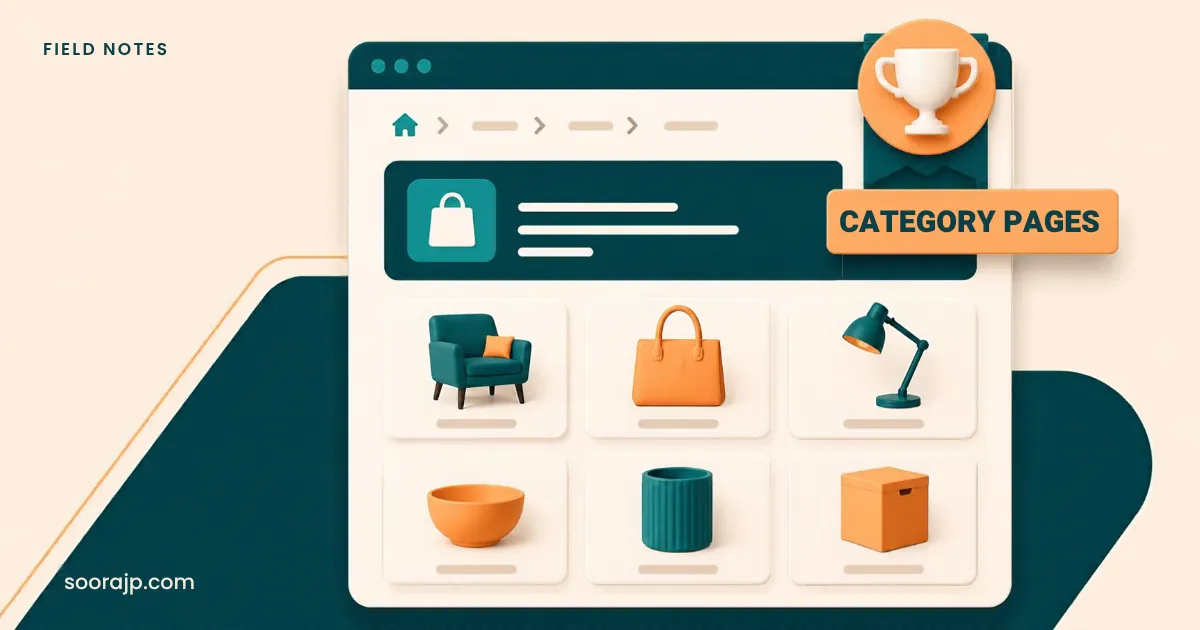
Category pages sit between your home page and your products. They help shoppers browse and help search engines find products. This guide uses Google’s ecommerce structure documentation for the link rules and offers a simple page template based on my own practice. Google’s page does not cover pagination or breadcrumbs, so this guide does not claim Google rules on them.
What a category page does
A category page groups similar products. It answers a shopper question: “what do you have in this group?”
It also gives crawlers a path from your menu to your products.
What Google says about store structure
Google’s ecommerce guidance describes a simple path: menu, then category, then subcategory, then product.1
| Rule | What it says |
|---|---|
| Link the path | Link from the menu to categories, subcategories and products1 |
| Link every product you want indexed | Google strongly recommends linking to all products you wish indexed1 |
| Use real links | Use a elements with href, so crawlers can follow them1 |
| Feature your best pages | Link top sellers and main categories from the home page1 |
| Internal links signal importance | More links to a page suggest higher relative importance1 |
| URLs do not carry structure | Google does not infer structure from URL paths alone1 |
A simple category page template
| Section | Purpose |
|---|---|
| Clear heading (H1) | Names the category in the words shoppers use |
| Short intro | Two or three sentences on what is in the category and who it suits |
| Subcategory links | Lets shoppers narrow down, and gives crawlers a path |
| Product grid | Name, image, price and a plain link to each product page |
| Buying help | A short guide on how to choose, near the grid or below it |
| Related categories | Links to near neighbours |
Step 1: check your link paths
- 1
Map the tree
List your top categories, subcategories and how many products each holds.
- 2
Find orphan products
Find products that no category links to, and add them.
- 3
Check the link type
Make sure category and product links are normal links with href.
- 4
Link from the home page
Feature your key categories and best sellers where it makes sense.
- 5
Keep the depth shallow
Shoppers and crawlers should reach any product in a few clicks. The right number is a judgement, not a Google figure.
Step 2: write helpful category content
Google asks you to make content for people first. The helpful content guidance is a useful check.2
| Helpful | Thin |
|---|---|
| Explains how to choose between products | Repeats the category name many times |
| Mentions real differences such as size, material and use | Copies a supplier description |
| Short and easy to scan | A long block of text at the bottom nobody reads |
| Links to the guides that answer common questions | No links to anything else |
How I approach it
I treat a category page as a shop aisle. A shopper should see where they are and what to pick next.
I also check the real shop path on a phone, because that is where many shoppers browse.
Common mistakes
Products with no category link.
Navigation that needs a script to load links.
Copied supplier text on every product.
Keyword-stuffed text at the bottom of the page.
Creating dozens of near-empty categories.
Quick questions
Do I need text on every category page?
Not always. Add text when it helps a shopper decide. Google gives no required length.
Should every product be in a category?
Google strongly recommends linking to all products you want indexed.1
Do URL paths show structure to Google?
Google says it does not infer structure from URLs, so use links.1
What about pagination and breadcrumbs?
The Google page I read does not cover them. Check Google’s current documentation before you rely on any rule.
Key takeaways
Category pages connect your menu to your products.
Google recommends linking to every product you want indexed, using normal links.
Link your key categories and top sellers from the home page.
Write short, helpful category text for shoppers, not for keywords.
Google’s page does not cover pagination or breadcrumbs, so treat advice on them as practice.