
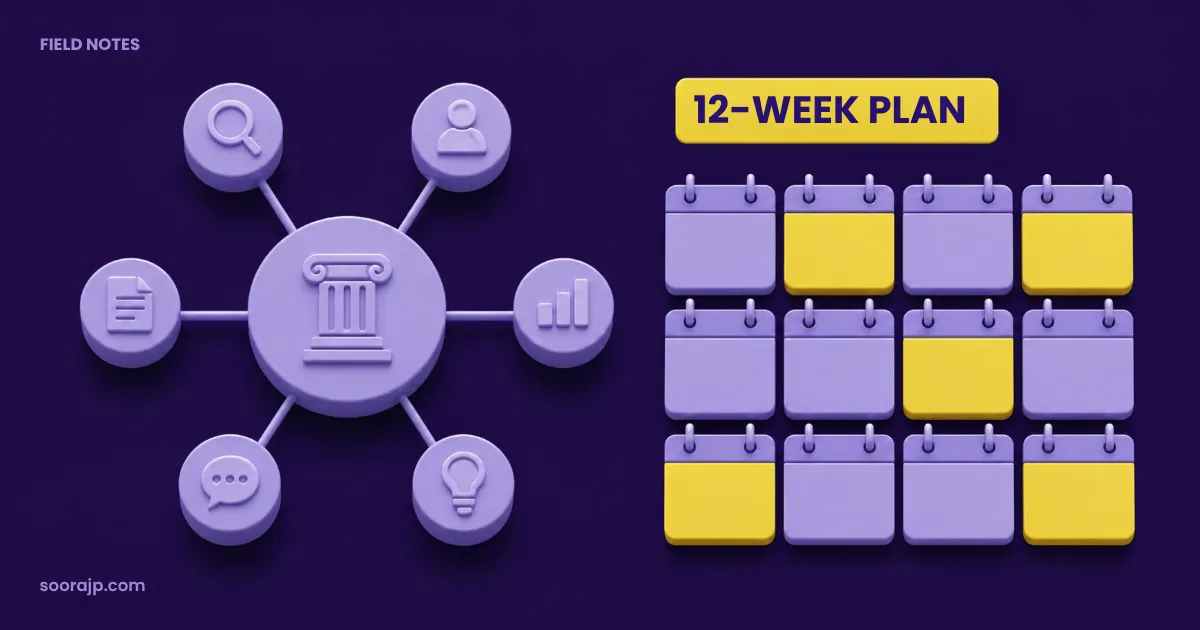
Content clusters are everywhere in SEO advice. The idea is simple: cover one topic in depth, and link the pages together. But the claims around them are often bigger than the proof. This guide explains what a cluster is, what is solid and what is opinion, and gives a 12-week plan you can follow. It also shows where Google’s own guidance backs the parts that matter.
What a content cluster is
A cluster has one broad page and many focused pages around it.
| Part | What it does | Example |
|---|---|---|
| Pillar page | Covers a broad topic at a high level and links to the details | “Local SEO: a complete overview” |
| Cluster pages | Each answers one narrow question or task in depth | “How to read a geo-grid report” |
| Links | Connect the pillar and the cluster pages in both directions | Pillar to cluster, and cluster back to pillar |
HubSpot, which popularised the model, describes it the same way. A broad pillar page links to a set of focused cluster pages.1
What is proven and what is opinion
Be careful here. Many cluster claims come from the people who sell cluster tools.
| Claim | What backs it | My read |
|---|---|---|
| Linked related pages help rankings | HubSpot’s own 2015 internal research, shown as a chart1 | Interesting, but a correlation with no method or sample shown |
| Clusters build topical authority | Stated as the mechanism1 | An idea, not shown on the page |
| Pages with sources, bios and dates get cited more by AI | HubSpot’s own AEO report1 | Correlation, from a vendor with a product to sell |
| Clear internal links help crawling and context | Google’s link guidance2 | Solid. Google says to link related resources with descriptive anchor text |
So use clusters as a planning tool. They make you cover a topic well. That alone is worth the effort.
What Google actually asks of your pages
Google’s people-first guidance gives questions you can use as a quality filter.
- 1
Is there original value?
Does the page offer original information, research or analysis beyond the obvious?3
- 2
Is it complete?
Does it cover the topic in a substantial, complete way?3
- 3
Is it better than the rest?
Does it provide substantial value compared with other pages in the results?3
- 4
Is it made for people?
Is the content mainly made to attract search visits, or to help people?3
Every cluster page must pass these questions on its own. Ten thin pages linked together are still ten thin pages.
Linking rules that work
Google crawls links that use an a element with an href attribute. Other formats may not be found.2
- 1
Use real links
Use plain anchor links. Do not rely on script-only buttons.2
- 2
Write descriptive anchor text
Say what the next page is about. Avoid “click here” and “read more”.2
- 3
Link in context
Place links inside the sentence that needs them, not in a long block at the end.2
- 4
Link both ways
Each cluster page links up to the pillar. The pillar links down to each cluster page where the subtopic appears.1
- 5
Cross-link with care
Link between cluster pages only when the topics truly overlap and the link helps the reader.1
- 6
Leave no orphans
Every page you care about should be linked from at least one other page.2
The 12-week plan
This plan is my own working method. The week numbers are a guide, not a rule. Adjust them to your team size.
| Weeks | Task | Output |
|---|---|---|
| 1 | Pick one topic where you have real experience, and list the problems your audience has | A one-page topic brief |
| 2 | Collect real questions from support, sales and search data | A list of 20 to 40 questions |
| 3 | Group questions into 6 to 10 cluster topics, and mark the search intent of each | A cluster map |
| 4 | Audit existing pages. Mark what to update, merge or write new | A page-by-page plan |
| 5 to 6 | Write the pillar page, with a clear overview and room for links | Draft pillar |
| 7 to 9 | Write or update three cluster pages per week | 6 to 9 cluster pages |
| 10 | Add links both ways and fix anchor text | A fully linked cluster |
| 11 | Check indexing, crawl paths and page speed | A clean technical check |
| 12 | Review: clicks, impressions, queries and questions answered | A decision on what to expand |
How to measure a cluster
Measure at the group level, not page by page. A cluster works together.
| Metric | Where to find it | What it tells you |
|---|---|---|
| Impressions and clicks for the group | Search Console, filtered by folder or URL list | Is the topic gaining visibility? |
| Queries per page | Search Console queries report | Are pages picking up the questions you planned? |
| Internal link counts | Crawl tool | Are pages linked, with good anchors? |
| Conversions or enquiries | Analytics | Does the topic bring useful visits? |
How I plan a cluster
I never start with keywords. I start with the questions a real client has asked me.
I also keep the pillar short. Its job is to orient the reader and send them to the right page, not to hold everything.
Common mistakes
Writing 30 thin pages to fill a map.
Linking every page to every other page.
Using “read more” as anchor text.
Skipping a pillar, so the pages never connect.
Expecting results in two weeks.
Quick questions
Do topic clusters improve rankings?
The evidence I found is from vendors and shows correlation. Clusters help you plan and link well. Treat ranking gains as a possible result.
How many cluster pages do I need?
Enough to cover the real questions. HubSpot suggests a pillar can support about 20 to 30 articles, but your topic may need fewer.1
Should the pillar be long?
Long enough to orient the reader. It should link to details, not repeat them.
Can I turn old posts into a cluster?
Yes. Audit them, merge overlaps, update weak ones and add links both ways.
Key takeaways
A cluster is a broad pillar plus focused pages, linked both ways.
The evidence for ranking gains is mostly from vendors. Use clusters mainly to plan and organise.
Every cluster page must be useful on its own.
Use real a href links, descriptive anchors and contextual placement.
Follow a simple 12-week plan, then measure the group, not single pages.